AI-Responsive Assignment Design (Mousel, 2023)
A Practical Framework for Faculty
By Tim Mousel, M.S.
"As AI has become prevalent, faculty need practical strategies to design meaningful coursework. This framework offers actionable guidance for transforming traditional assignments into AI-responsive learning experiences."
The Reality We're Facing
The classroom of 2025 exists at a critical inflection point. AI tools are no longer a future-tense concept; they are a present-day reality in our students' workflows.
Students Are Already Using AI
Surveys show 30-60% of college students have used generative AI for coursework. Whether we acknowledge it or not, these tools are part of their academic toolkit.
Traditional Assignments Are Vulnerable
Standard essays, reports, and problem sets can often be completed by AI in seconds. This means many conventional assignments no longer effectively measure student understanding.
Why Banning and Detection Aren't the Answer
- Detection Isn't Reliable: AI detection tools produce false positives and negatives, and they are particularly biased against non-native English speakers. This approach creates adversarial relationships.
- Banning Is Ineffective: Banning AI use doesn't prepare students for professional environments where AI is already becoming standard practice.
A Fundamentally Different Approach
We need a fundamentally different approach: intentional design that acknowledges this new reality.
The Core Concept: Two Valid Approaches
The key is to be intentional rather than reactive. Your choice of assignment design depends entirely on your specific learning objectives. Both of these approaches are pedagogically sound.
1. AI-Integrated Assignments
In this approach, AI becomes a transparent learning tool that enhances critical thinking.
- Use AI as a thinking partner or research assistant
- Make AI use transparent and documented
- Assess critical thinking, synthesis, and evaluation
- Prepare students for real-world professional AI use
- Build metacognitive awareness about AI's strengths and limitations
2. AI-Resistant Assignments
Sometimes the learning goal requires human cognitive processes that AI would short-circuit.
- In-class work, including exams and timed writing
- Oral presentations, debates, and discussions
- Process portfolios showing iterative thinking
- Personal reflections grounded in lived experience
- Assignments requiring contextualized, local knowledge
The ARAD Framework: 5 Steps to Intentional Design
ARAD stands for AI-Responsive Assignment Design. This systematic approach helps you redesign any assignment with clarity and purpose.
A simple way to remember the framework is with the acronym GOALS:
G
GOAL
What's the true learning objective?
O
OPENNESS
Can AI support learning without compromising it?
A
ADAPT
Redesign the assignment with intentional AI integration or resistance
L
LINK
Align your rubric to the new process
S
STUDY
Pilot the assignment, gather feedback, and revise
Deep Dive: The 5 Steps in Practice
Before redesigning anything, get crystal clear on what you want students to learn—not just what you want them to do. This distinction is critical.
Ask the Right Question
"What do I want students to LEARN?" rather than "What task should they COMPLETE?"
Your goal becomes your North Star. Focus on:
- Skill-Based Goals: Critical thinking, analysis, problem-solving, argumentation
- Process-Based Goals: Research methodology, design thinking, iterative revision
- Knowledge-Based Goals: Understanding concepts, applying theories to new contexts
- Creative Goals: Developing voice, original argumentation, innovative solutions
Once your goal is clear, ask one fundamental question with intellectual honesty:
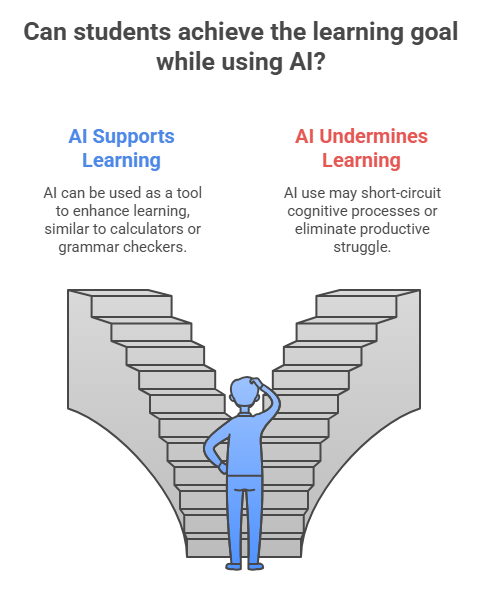
"Can students achieve this goal WHILE using AI?"
YES → AI Can Support Learning
If students can meet the objective while using AI like a calculator or grammar checker, then design an AI-integrated assignment. Example: Learning to evaluate sources or apply frameworks to real problems.
NO → Ask Why Not
If AI use would undermine the learning, identify why:
- Does it short-circuit the cognitive process?
- Does it eliminate the productive struggle?
- Does it obscure understanding?
Based on your answer in Step 2, you will adapt the assignment.
Path 1: AI-Integrated Redesign
Make AI use transparent, purposeful, and assessable. Your redesign should:
- Specify Transparency Requirements: Require students to document prompts, transcripts, or iterations. Make AI use visible.
- Focus on Process Over Product: Build in stages, annotations, or reflections that reveal cognitive work.
- Define Appropriate Tools: Be specific about what's permitted and why (e.g., ChatGPT for brainstorming, Grammarly for editing).
- Establish Clear Boundaries: Explain what remains off-limits and the pedagogical reasoning behind it.
- Provide AI Literacy Support: Consider tutorials on prompt engineering or evaluating AI output.
Path 2: AI-Resistant Redesign
If AI undermines the goal, your redesign focuses on tasks that are inherently human-centric.
- In-Class / Proctored Work: Timed writing, in-class exams
- Verbal Communication: Oral presentations, debates, Socratic discussions
- Process-Oriented Work: Portfolios that show iterative drafts, lab notebooks
- Personal & Localized Content: Personal reflections, assignments tied to a specific local event or lived experience
Your grading rubric must align with what you're actually trying to assess. When AI is involved, traditional rubrics focused on "grammar" or "formatting" become less meaningful.
Ask: "What does success look like with AI involved?" Your new rubric should evaluate:
- Metacognition: Can students reflect thoughtfully on how/why they used AI? Do they recognize its limitations?
- Integrity & Transparency: Did they document AI use honestly and completely, following guidelines?
- Synthesis & Evaluation: Do they critically evaluate AI suggestions rather than accepting them uncritically? Have they added substantive original thinking?
Sample Rubric Criteria
| Criterion | ✓ Excellent | ✗ Needs Work |
|---|---|---|
| AI Use Documentation | Provides clear transcript of AI interaction with thoughtful prompts; explains reasoning behind prompt choices | Missing transcript, vague description of AI use, or no evidence provided |
| Critical Analysis of AI Output | Identifies specific strengths and weaknesses in AI responses; corrects errors or gaps; evaluates quality of reasoning | Accepts AI output uncritically; doesn't identify flaws or limitations; treats AI as authoritative |
| Original Thinking | Uses AI as starting point but develops independent arguments; adds substantive insights beyond AI suggestions; shows personal engagement | Relies entirely on AI ideas with minimal original contribution; lacks personal perspective or synthesis |
| Evidence & Support | Integrates course materials and external sources; goes beyond what AI provided; demonstrates research skills | Only uses sources suggested by AI; doesn't verify information or seek additional evidence |
Don't expect perfection on your first attempt. Treat assignment redesign as an experimental, iterative process. You're learning a new pedagogical approach, so give yourself permission to adapt.
- Start Small: Try your redesigned assignment with one section or as a low-stakes task first.
- Ask Students for Feedback: Ask them, "What did you learn *because* of AI, not just *with* AI?" Their answers reveal if the goal was achieved.
- Revise Based on Reality: Adjust the assignment based on what actually happened. Were instructions clear?
- Expect Surprises: Students will use AI in creative ways you didn't anticipate. Learn from both productive and problematic uses.
Putting It All Together: Redesign Examples
See how the ARAD framework transforms traditional assignments into meaningful, AI-integrated learning experiences.
Old Assignment
"Write a 5-paragraph essay analyzing the effectiveness of current climate change policy... 1,500 words minimum."
The Problem
This is completely vulnerable to AI. It evaluates a product (the essay) rather than student thinking (analysis, synthesis). You can't tell if the student understands the topic.
New AI-Integrated Redesign
Part 1: AI Argument Generation (20%)
Use ChatGPT to generate three well-reasoned arguments that oppose your position. Submit the complete AI transcript.
Part 2: Critical Analysis (60%)
Write an analysis that identifies which AI arguments are valid and which contain flaws, using evidence from course readings.
Part 3: Metacognitive Reflection (20%)
Write a reflection: What did you learn about AI's capabilities and limitations? How did engaging with counterarguments change your thinking?
What Changed?
The new design transforms AI from a threat into a tool. Students must use AI as a thinking partner and then genuinely understand the content to critically evaluate the AI's output and identify its flaws—work the AI can't fake. The process is made visible via the transcript.
Old Assignment
"Write a 10-page research paper analyzing the causes and consequences of the American Civil War."
The Problem
AI can generate historically accurate, well-cited papers. You're evaluating a product, not historical thinking.
New AI-Integrated Redesign
Phase 1: Use ChatGPT to generate a timeline of 15 key Civil War events with explanations.
Phase 2: Write an analysis that identifies 3 events the AI overlooked or misinterpreted. Explain why these omissions matter. Use primary sources to correct AI's account.
Phase 3: Reflect on what this reveals about how AI handles historical complexity and causation.
What You're Actually Assessing
Historical thinking: the ability to identify gaps in narratives, understand causation, and evaluate sources—not just factual recall.
Old Assignment
"Write a standard lab report with Introduction, Methods, Results, Discussion, and References sections."
The Problem
AI can write formulaic lab reports. A generic Methods section doesn't reveal if students understand scientific precision.
New AI-Integrated Redesign
Part 1: Use AI to draft your Methods section based on notes from your lab session.
Part 2: Annotate the AI draft, marking at least 5 places where the AI's description is too vague, inaccurate, or non-replicable.
Part 3: Revise those sections with precise details from your actual procedure, explaining *why* each detail matters for replication.
What You're Actually Assessing
Scientific methodology and precision: understanding why exact protocols matter and recognizing the difference between generic and replicable procedures.
Old Assignment
"Create a comprehensive marketing plan for a product of your choice. Include market analysis, target audience, 4 Ps, budget, etc."
The Problem
AI can generate professional-looking marketing plans. You can't determine if students understand strategic decision-making.
New AI-Integrated Redesign
Step 1: Generate 3 different AI marketing strategies for your product. Submit all prompts and outputs.
Step 2: Analyze each strategy using Porter's Five Forces framework. Create a matrix evaluating threats/opportunities for each.
Step 3: Write an executive memo defending which strategy you'd implement and why, using data to argue *against* the other AI suggestions.
What You're Actually Assessing
Strategic analysis and business judgment: the ability to evaluate options using analytical frameworks, make data-driven decisions, and justify strategic choices—not just produce documents.
Overcoming Common Faculty Concerns
These concerns come up repeatedly in faculty discussions. Here are honest, practical responses:
"This feels like giving up"
It's not surrender, it's strategic adaptation. You're not lowering standards; you're teaching students to think *with* AI rather than be *replaced* by AI. This is a higher-order skill that employers desperately need.
"I don't know enough about AI"
You don't need to be an AI expert. Start small, experiment alongside your students, and be transparent about learning together. Many successful AI-integrated assignments come from faculty learning with their classes.
"Students will cheat anyway"
When the process is more valuable than the product, cheating becomes much harder and less appealing. If learning happens through documented thinking, reflection, and iteration, there's nothing to "cheat" on.
"This takes too much time"
The initial redesign requires time investment, yes. But it's less time than constantly policing AI use, dealing with academic integrity cases, or redoing assignments that don't work. Long-term, it saves time and improves learning.
Your First Step: Pick ONE Assignment
The biggest mistake is trying to redesign everything at once. Instead, identify a single assignment where AI-responsive design would make the most difference.
Choose One Assignment Where:
Students Currently Struggle
Pick an assignment where students consistently perform poorly or seem disengaged. Redesigning it might improve learning outcomes regardless of AI.
AI Use Is Likely Happening
If you suspect students are already using AI, make that use transparent and pedagogically valuable instead of fighting it.
AI Could Genuinely Enhance Learning
Sometimes AI can be a legitimate tool—for generating data sets, creating counterarguments, or drafting initial versions that students critique.
Once you've chosen your assignment, work through the five ARAD steps systematically.
Practice: Draft Your First ARAD Redesign
Use the space below to outline your redesign. Based on the assignment you picked, walk through the 5 ARAD steps.
Suggested Format
- Step 1: My learning goal is...
- Step 2: AI's role is... (Integrate/Resist) because...
- Step 3: My redesign will involve...
- Step 4: I will align my rubric by assessing...
- Step 5: I will pilot this by...
Activity Available for Enrolled Students
This hands-on activity is available to enrolled students. Sign up to save your work, submit activities, and track your progress through the course.
Enroll NowYour Goal: Pedagogical Value
The goal isn't to eliminate AI use. The goal is to design assignments where AI use is transparent, pedagogically valuable, and develops the critical thinking skills students actually need in a world where AI is ubiquitous.
We're not trying to return to a pre-AI world. Instead, we're preparing students to work alongside AI while retaining the human capacities that matter most: judgment, creativity, ethical reasoning, and metacognitive awareness. This is an opportunity to clarify our pedagogical priorities and design more meaningful learning experiences.
Resources & Next Steps
Try AI Yourself
Spend an hour using ChatGPT or Claude to complete one of your own *old* assignments. Understanding its capabilities and limitations firsthand is invaluable.
ARAD Framework GPT
Receive step-by-step guidance through the complete ARAD Framework using this custom GPT.
Launch ARAD GPTConnect With Me, Tim Mousel
Let's continue the conversation on AI-responsive assignment design!